NASA Carbon Capture Challenge 2026

AERO-LITE

A regenerative CO₂ preprocessor for lunar habitats. Started mid-March 2026 after an email from Space Center Houston. Built by an 8th grader.

0.99 lb / unit
~8 watts avg
3 live sensors
6 min cycle

The Problem

ISS Solution: CDRA

661 pounds. 600 watts.

Vents CO₂ into space.

Does not work on the Moon — no 'into space.'

Backup: LiOH Canisters

Single-use. 1,440 needed for 180 days.

Over 6,000 pounds of dead mass.

The math does not close.

AERO-LITE

Regenerative. 0.99 lb. ~8W.

Captures, releases, repeats.

No canisters. No vents. Just zeolite and heat.

How It Works

1

DRY

Silica gel strips moisture from cabin air. Humidity kills CO₂ capture efficiency, so this happens first.

2

TRAP

Zeolite 13X bed captures CO₂ at room temperature. Nitrogen and oxygen pass through. Clean air returns to the cabin.

3

RELEASE

Heat to 248°F. CO₂ desorbs from zeolite as concentrated gas. Chamber is sealed — cabin loop stays isolated.

4

COMPRESS

Sweep gas pushes concentrated CO₂ through compressor into buffer tank at 22 psi. Steady feed for the Sabatier reactor.

The cycle: ADSORB (~5 min) → REGEN (~1 min) → PURGE (~15 sec). The buffer tank decouples AERO-LITE's cycle from the Sabatier's continuous demand.

The Prototype

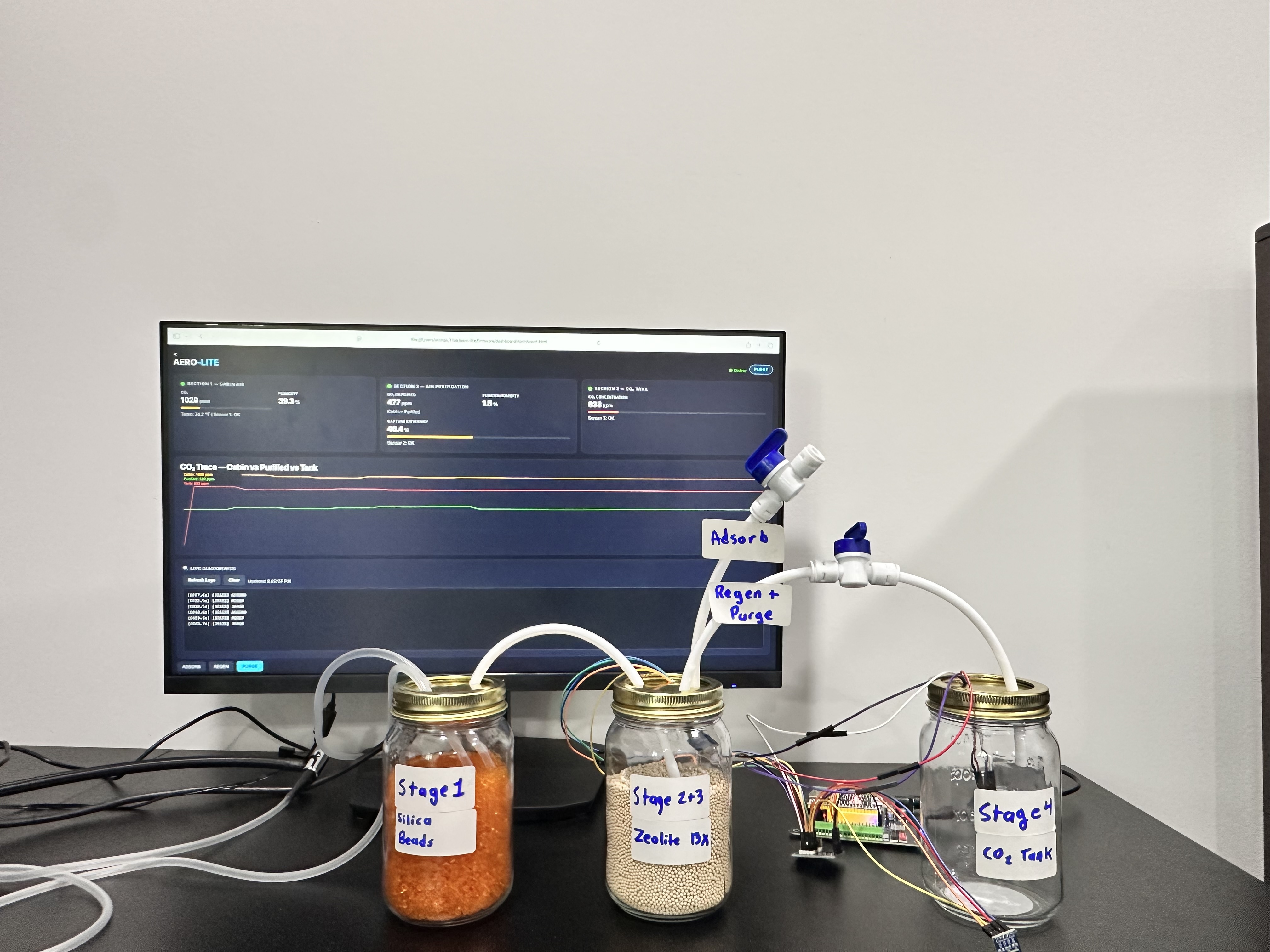
AERO-LITE Phase 1 prototype — three mason jars with zeolite beads, silica gel, and CO₂ sensors on a desk

AERO-LITE Phase 1 prototype — three mason jars with zeolite beads, silica gel, and CO₂ sensors on a desk

This is not a rendering. It is three mason jars on my desk, a live ESP32-S3, and a web dashboard that updates every second.

  • Stage 1: Silica gel beads (orange, indicating type)
  • Stage 2+3: Zeolite 13X pellets in a shared bed
  • Stage 4: CO₂ buffer tank with pressure sensor
  • Control: ESP32-S3 DevKitC-1 with TCA9548A multiplexer
  • Sensors: 3× SCD41 (Cabin, Purified, Tank)
  • Dashboard: Pure HTML/CSS/JS, polling JSON API at 1 Hz

Live data: Cabin 1,029 ppm → Purified 477 ppm. Capture visible in real time.

What I Learned

💡 Capture First, Compress Later

My first design compressed cabin air directly. The math showed 99% of that energy compresses nitrogen, not CO₂. I felt stupid. Then I fixed it. That is engineering.

🔥 Thermal Swing > Pressure Swing

Pressure swing uses less energy, but vacuum seals in microgravity are catastrophic leak risks. A PTC heater with a bimetallic cutoff is safer — even if the ESP32 crashes.

📊 The Dashboard Proves It

Judges see 50 slide decks. They remember the one with a photo of real hardware and a URL where they can watch numbers change. Proof beats promises.

Repository

All firmware, schematics, 3D models, and documentation are open source.