AERO-LITE · SPACE SYSTEMS

How could astronauts manage CO₂ on the Moon?

A regenerative CO₂ preprocessor concept for future lunar habitats — prototyped by an 8th grader on his desk.

I started AERO-LITE in mid-March 2026 after an email from Space Center Houston described a Carbon Capture Challenge. I had learned a little about electronics and robotics before this, but almost nothing about air chemistry. I decided to learn it the way I usually do: by building something real and seeing what it can actually prove.

Top Individual Award · Middle School Division · NASA Carbon Capture Challenge 2026

3 live CO₂ sensors observed in the Phase 1 prototype, updating every second via a web dashboard OBSERVED · on the bench
1,029 → 477 ppm one recorded dashboard snapshot (cabin sensor → purified sensor) OBSERVED · one specific reading, not validated capture efficiency
~0.99 lb/unit · ~8 W · 6:15 early estimates for mass per unit, average power, and design cycle schedule DESIGN TARGETS · estimated, not measured
01 · THE PROBLEM

Why was a lunar habitat an interesting place to think about air?

Space Center Houston's Carbon Capture Challenge asked students to think about how future Moon habitats would manage the CO₂ that people exhale — with limited power and mass. That constraint is what pulled me in: on Earth, fresh air solves most buildings' CO₂ problems. In a sealed habitat, you have to decide where the CO₂ actually goes.

The station-grade answer today is a big machine that vents CO₂ overboard. And everything I read about keeping people alive in a surface habitat comes back to the same idea: the air will be recycled, so each part of the system — capture, release, storage — becomes part of a loop, not a one-way stream.

I am not going to pretend an 8th grader solved habitat engineering. What I had was a question from people who run a real space center, three months to try something, and a habit: when I don't understand something, prototype it small and see what the numbers say.
02 · THE DECISION

The calculation that changed AERO-LITE

My first concept looked elegantly simple: pull cabin air into a compressor, squeeze it, get a concentrated CO₂ stream. One stage instead of several. Less mass, fewer parts. I liked it so much I started sketching the compressor placement before doing the arithmetic.

KEY DECISION · CAPTURE BEFORE COMPRESSION

Cabin air is mostly not CO₂ — so compressing it compresses mostly everything else.

Cabin air is mostly nitrogen and oxygen. Squeezing it does not separate the components; it just makes harder-to-manage mixed gas. When I sat down with the composition, the "one elegant stage" stopped looking elegant — it would spend the project's energy on ~99% of the air that isn't CO₂.

So AERO-LITE reversed direction: capture CO₂ first, then — later in the design — compress a stream that is actually CO₂-rich. That single decision is why the prototype is a sorbent bed with sensors, not a compressor with plexiglass. The power and mass savings the redesign promises are estimates; testing them is exactly the work I have listed as unfinished.

03 · HOW IT WORKS

Four stages — two on the bench, two on paper

The concept is a four-stage loop. Honesty check before anything else: the first two stages exist as real hardware. The last two are design stages — the concept for them exists, the hardware outcome does not.

01

DRY

BUILT

Silica gel strips moisture first — humidity kills CO₂ capture efficiency, so this stage has to come first.

02

TRAP

BUILT

A zeolite 13X bed captures CO₂ at room temperature; nitrogen and oxygen pass through. Three live sensors watch the result.

03

RELEASE

DESIGN STAGE

Controlled heating would release the captured CO₂ for reuse. The first prototype only simulated heater control.

04

COMPRESS

DESIGN STAGE

A CO₂-rich stream would be compressed into a buffer tank for possible downstream use. Not built, not integrated.

Intended control schedule: ADSORB (~5 min) → REGEN (~1 min) → PURGE (~15 s), about 6 minutes 15 seconds total. This is a design setting, not a validated full regeneration-cycle measurement. The buffer tank idea is meant to smooth the intermittent output; that integration still needs to be tested.

Control ESP32-S3 DevKitC-1
Sensor hub TCA9548A I²C multiplexer
Sensors 3× SCD41 — cabin, purified, tank
Sorbents Silica gel (orange, indicating) · Zeolite 13X
Stage 4 hardware CO₂ buffer tank with pressure sensor (concepted)
Dashboard HTML/CSS/JS, polling JSON at 1 Hz
04 · BUILDING, TESTING & EVIDENCE

What the prototype actually shows

I wanted the first build to be the least impressive possible version of the idea: jars, beads, sensors — not a rendering, not a sci-fi panel. A bench prototype can tell you whether a component behaves; it cannot yet tell you whether the whole loop is efficient.

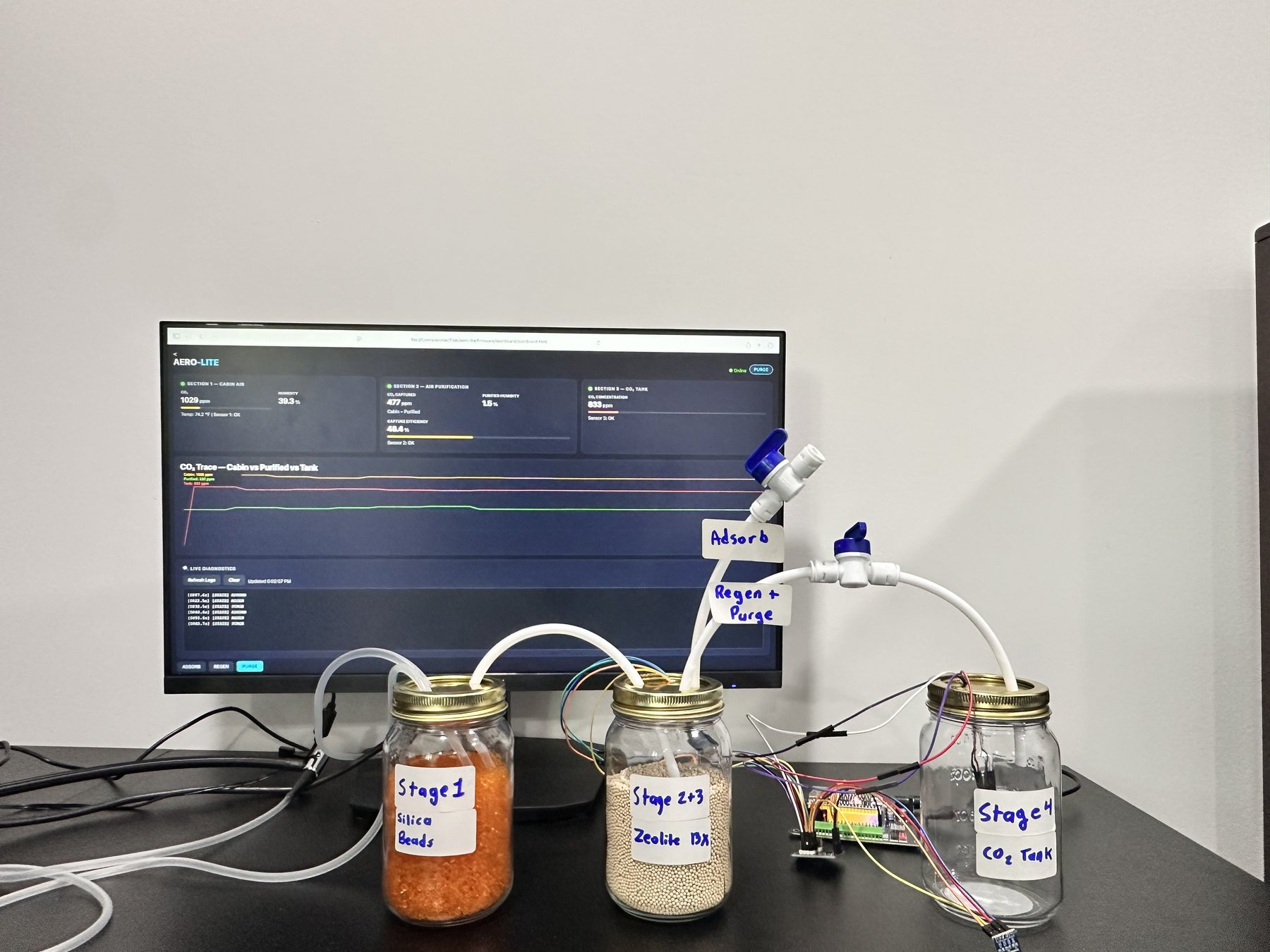
FIG. 02 · THE BENCH AERO-LITE Phase 1 prototype — three mason jars with zeolite beads, silica gel, and CO₂ sensors on a desk
Three mason jars: silica gel, zeolite 13X, and a buffer-tank stand-in — with the live sensors between them.
OBSERVED

One recorded dashboard snapshot: cabin sensor 1,029 ppm; purified sensor 477 ppm.

These readings illustrate live sensor output from real hardware. A single snapshot does not establish capture efficiency or sustained performance.

Reliable across the three sensors — including the I²C channel selection behind them — took its own debugging story.

DESIGNED (ESTIMATED)
  • ~0.99 lb / unit — early mass estimate
  • ~8 W average — estimated operating power
  • 6:15 cycle — intended schedule
  • Regeneration amount & resulting CO₂ concentration — unmeasured

LIVE DASHBOARD The CO₂ dashboard is real, not a mockup — a web UI served by the ESP32-S3 that updates every second. The readings shown under OBSERVED above were captured from it as live sensor output; this page describes it through those readings and the bench photograph rather than a stylized UI frame.

“This is not a rendering. It is three mason jars on my desk, a live ESP32-S3, and a web dashboard that updates every second.”

05 · CHALLENGES, LESSONS & NEXT STEPS

What fought back — and what I'd test next

The hard parts weren't the ones I predicted. None of these lessons would have appeared in a slideshow; they only showed up at the bench.

L01

Compression is not separation

My original design rested on a mistake I didn't notice until I checked the composition of air. Squeezing mixed gas doesn't sort it. Catching this early cost me a week of sketches and saved the whole project — the numbers proved it, so I redesigned before building.

L02

Three sensors that wouldn't answer

The three SCD41 sensors sat behind an I²C multiplexer and kept going silent. The channel-mask math was right, but the code didn't always select the right channel before each read. Three days of testing assumptions one at a time fixed it — and I now write the intended channel selection right before every sensor communication.

L03

Heat beats vacuum — for now

For releasing CO₂ from the zeolite, a pressure-swing approach would use less energy. But vacuum seals on moving hardware in rough conditions are leak risks. A PTC heater with a bimetallic cutoff is the safer path for this prototype — even if the microcontroller crashed, the cutoff would remain. That trade-off is a design decision, not a proven result.

L04

A dashboard is evidence, not a verdict

Live readings made the project feel real — and I had to learn not to oversell them. One clean-looking number is a snapshot, not an efficiency measurement. Explaining that distinction to judges taught me as much as building it did.

Unfinished, on the record: repeatable regeneration (how much CO₂ actually comes back off the zeolite, at what concentration), compressor and buffer-tank integration, and controlled measurements of power and mass against those estimates. Next: build the regeneration stage for real, run controlled capture/release cycles with logged data, and replace the estimates above with measurements — even if the numbers get worse.

06 · CONTINUE EXPLORING

From the build log

These notes cover the messier parts of this project — the calculation, the debugging, and what it took to explain it honestly.

APR 2026

The Calculation That Changed AERO-LITE

I wanted to compress cabin air directly, but compression alone would not separate out CO₂. The numbers made me rethink the design: capture CO₂ first, then consider compressing a concentrated stream. That is where AERO-LITE changed direction.

DESIGN · MATH · ITERATION Read the build note →
MAY 2026

Three Days in I²C Debugging Hell

My three SCD41 sensors were not responding reliably through the I²C multiplexer. The channel-mask calculation was correct, but my code was not consistently selecting the right channel before sensor reads. A story about testing assumptions, the Serial Monitor, and why sleep matters.

ESP32 · I2C · DEBUGGING Read the build note →
MAY 2026

Submitting AERO-LITE to NASA

Eight slides and a prototype with live CO₂ readings. What I learned about explaining a technical project without exaggerating what my first prototype actually proved.

NASA · COMPETITION · STORYTELLING Read the reflection →

Firmware, system documentation, and competition materials are open source in the project repository.